The Lead Ladder: Why Most Businesses Misunderstand Where Leads Come From
Cutting a marketing channel because it doesn't convert directly is one of the most common and costly mistakes businesses make. Here's why your attribution model is lying to you, and what to do about it.
Securing leads is a costly affair for most businesses with lots of unknowns to cope with that don’t allow a business to clearly define what channels are working and what are not. This is further muddied by the practice of attributing the origin of a lead as the final source it converted from.
The reality of how a lead is sourced is much more nuanced and requires a more holistic stance in order to truly maximise success.
What is a lead?
It's worth being precise here, because the definition shapes everything that follows. A lead is a positive enquiry or expressed interest from a potential customer in a product or service you offer. The customer has reached out by phone, email, form submission, or direct message and signalled that they want to know more. A lead is not the identification of a person or business that you expect would use products or services of the type you provide but has not expressed any interest.
The Lead Ladder: How the Journey Works
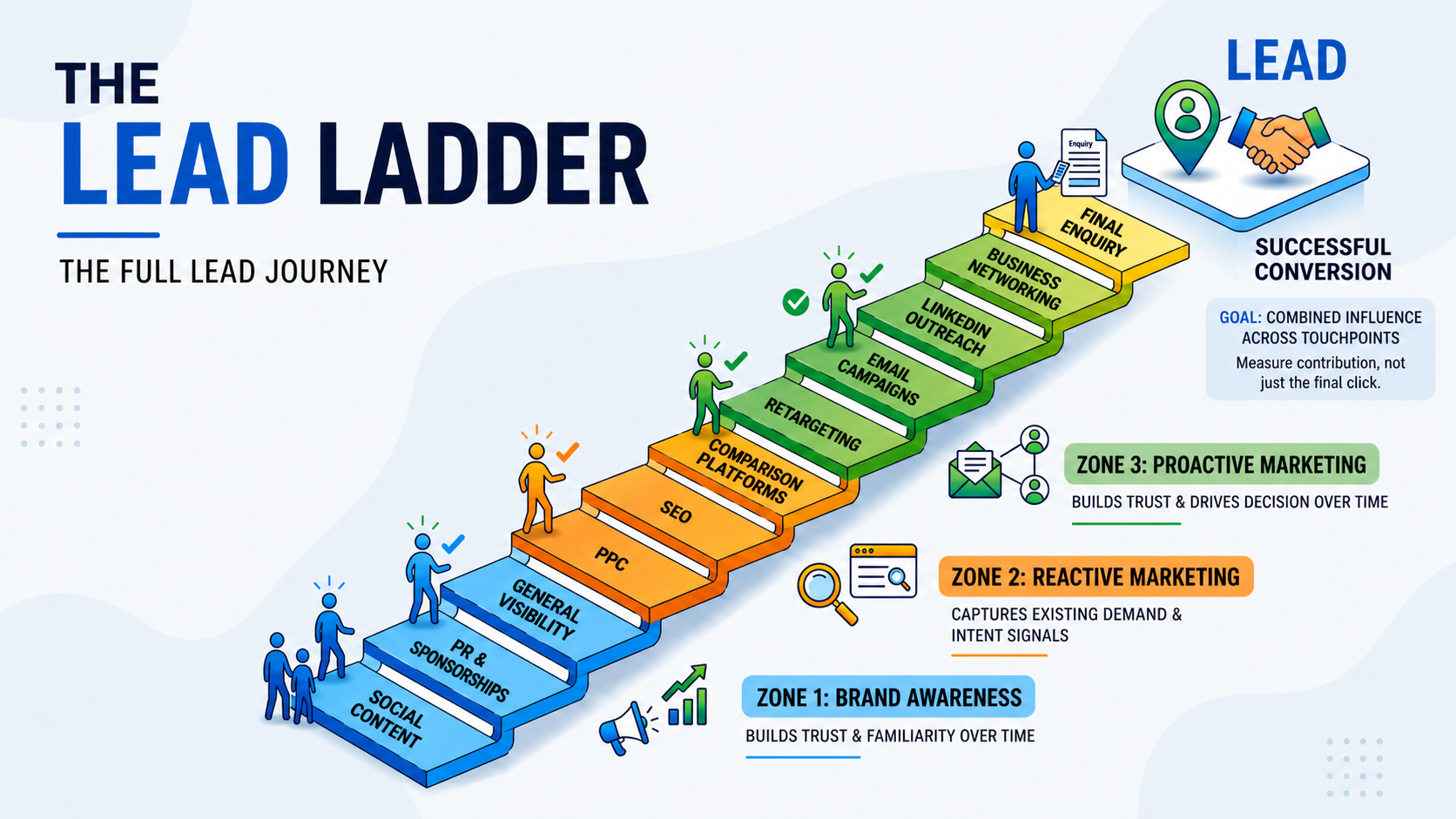
Every potential customer starts somewhere. Maybe they spot your name on a sponsored post, or a colleague mentions you in passing. That first moment of awareness is the bottom rung of the ladder. From there, each subsequent interaction carries them one step closer to making contact.
How many steps does it take before conversion? It depends. High-value or complex services tend to require more convincing, typically somewhere between 5 and 10 interactions before a prospect picks up the phone or fills in a form. Simpler purchases may need fewer. But one thing holds across almost every sector: nobody converts at first contact. Research from Demand Gen Report found that 62% of B2B buyers consume between three and seven pieces of content before speaking to a salesperson. Perhaps most telling: research from 6sense found that 81% of B2B buyers already have a preferred vendor in mind before they ever speak to a sales representative. The top of the ladder must be earned.
5-10
Average interactions before a lead converts
1
Interaction most businesses measure and credit.
3
Types of interaction that move a prospect closer.
The Three Types Of Interaction And Why All Three Matter
Not every marketing channel is designed to convert directly, and judging them as if they should is where the trouble starts. There are three distinct types of interaction that work together to move a prospect up the ladder:
1. Brand awareness:
General visibility that builds trust and familiarity over time. Display ads, social content, PR, sponsorships. Rarely converts directly but without it, everything else works harder.
2. Reactive marketing:
Getting in front of customers when they signal intent. Using PPC, SEO, comparison platforms. This is where active research happens, your prospect is weighing up their options.
3. Proactive marketing:
Reaching customers based on what you already know. Retargeting, email campaigns, LinkedIn outreach, business networking, targets people already on the ladder.
A well-structured marketing strategy uses all three. Remove any one of them and you shorten the ladder for every prospect currently trying to climb it.
Your Window Of Opportunity And Why Timing Matters
Understanding the ladder is only part of the picture. The other critical factor is timing. At any given moment, only a fraction of your potential customers are actively in the market for what you offer. That period during which a prospect is researching, comparing, and building their shortlist is finite.
If your brand isn't visible and familiar enough within that window, you won't make the shortlist. It doesn't matter how good your product is, or how strong your reputation. A prospect who reaches the decision stage without having encountered your brand enough times will simply go elsewhere, to whoever was consistently on their radar while they were looking.
The goal isn't just to be visible. It's to have accumulated enough interactions, and enough rungs climbed by the time a prospect reaches the point of decision. Brand awareness built before that window opens is what makes reactive and proactive marketing convert when the moment comes.
Why Attribution Models Are Misleading You
Here's where most marketing decisions go wrong. Many analytics platforms, including GA4 by default, use last-click attribution, meaning the final channel a prospect touched before converting gets 100% of the credit. Everything that came before counts for nothing.
In practice, a prospect who clicked PPC ads, read case studies, and returned twice through organic search before finally typing your brand name directly into Google shows up in your data as a direct lead. The paid campaigns that kept your brand visible throughout their research are invisible. As a result, they get cut, lead volume drops a few months later and nobody connects the two.
The same logic works in reverse. Organic content that builds early awareness loses out to the PPC ad a prospect happened to click on the day they decided to act. Referrals and networking rarely appear in attribution data at all, despite often being among the most influential interactions in the whole journey.
There's a related problem that compounds this further: large parts of the buyer journey are simply invisible. When someone shares a link internally the referrer data disappears entirely. The next person who clicks that link arrives as "direct" traffic, with no trace of how they found you. In B2B especially, where buying decisions involve multiple stakeholders, this is common.
Tools like Hotjar and Lead Forensics help build a more complete picture. Lead Forensics uses reverse IP lookup to identify which companies are visiting your site even when individual tracking fails so if three people from the same business visit your pricing page before anyone reaches out, you can see that. Hotjar captures session recordings and heatmaps, showing what people did once they arrived: which pages they read, where they lingered, what they came back to. Neither tool is a silver bullet, but together they add a qualitative layer that pure attribution data can't give you.
The channel a customer used to make contact is often the least important part of the story. It's just the only part most businesses are measuring.
What To Consider Before Changing Your Channel Mix
None of this means every channel deserves unlimited budget. It means that before making any significant change, you need to consider the indirect effect on leads you're currently receiving because that effect can take weeks or months to show up, and by then the connection is easy to miss. Before reducing or pausing a channel, ask three things:
1. What is it contributing before the final interaction?
2. What is the quality of the audience it reaches?
3. How long before the consequences of this decision become visible?
A channel that rarely closes deals may still be the reason prospects are getting close enough to close at all. Cut it without understanding its role and you're not saving budget: you're removing rungs.
Building A Strategy Around The Full Ladder
The businesses that get this right generate leads more predictably and at a lower cost over time not because they've found the one channel that works, but because they've invested in the full journey rather than chasing last-click conversions. This approach does require some deeper strategic thinking but does reduce waste in turning off channels that stop a volume of potential customers from ever reaching the top of your lead ladder.